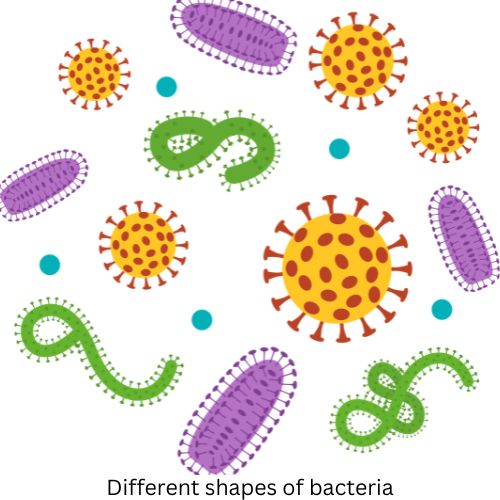
Bacteria are microscopic, single-celled organisms found in soil, water, food and living organisms. Some are beneficial, while others cause diseases. They play important roles in agriculture, food production, decomposition and biotechnology.
In our introductory guide to microorganisms, we explored the major groups studied in microbiology. In this article, we will focus on bacteria, their structure, types, reproduction and importance for competitive examinations.
What Are Bacteria?
Bacteria are unicellular prokaryotes. Unlike eukaryotic organisms, their cells do not have a membrane-bound nucleus. Their genetic material is located in a region called the nucleoid.
Most bacteria possess a cell membrane, and many have a cell wall. They lack membrane-bound organelles such as mitochondria but contain ribosomes for protein synthesis.
Structure of a Bacterial Cell
A typical bacterial cell contains several important structures:
- Cell wall: Provides shape and structural support in most bacteria. Most bacterial cell walls contain peptidoglycan.
- Cell membrane: Regulates the movement of substances into and out of the cell.
- Cytoplasm: The internal material where many cellular reactions occur.
- Nucleoid: Contains the bacterial chromosome, generally a circular DNA molecule.
- Ribosomes: Help synthesise proteins.
- Flagella: Present in some bacteria and used for movement.
- Pili and fimbriae: Help certain bacteria attach to surfaces; specialised pili may also transfer genetic material.
Not every bacterium possesses all these structures. For example, Mycoplasma lacks a cell wall, making it an important exception to remember for exams.
Different Shapes of Bacteria
Bacteria are commonly classified according to their shape.
1. Cocci: Spherical or round-shaped bacteria. They may occur singly, in pairs, chains or clusters. Examples include Staphylococcus and Streptococcus.
2. Bacilli: Rod-shaped bacteria. Examples include Bacillus subtilis and Escherichia coli. Not all strains of E. coli cause disease.
3. Spirilla: Spiral-shaped bacteria with a relatively rigid spiral form.
4. Vibrios: Curved or comma-shaped bacteria. Vibrio cholerae, which causes cholera, is a well-known example.
Exam tip: Remember the sequence—cocci: spherical, bacilli: rod-shaped, spirilla: spiral-shaped and vibrios: comma-shaped.
How Do Bacteria Reproduce?
Most bacteria reproduce through binary fission, an asexual process in which a cell replicates its DNA and divides into two daughter cells. Under favourable conditions, some bacteria multiply rapidly.
Bacteria can also exchange genetic material through conjugation, transformation and transduction. These processes contribute to genetic variation but are different from ordinary cell division.
Some bacteria form resistant structures called endospores under unfavourable conditions. Endospores help them survive environmental stress; they are not reproductive structures.
Beneficial Roles of Bacteria
Bacteria are essential to many natural and human activities.
- Decomposition: They break down dead organic matter and help recycle nutrients.
- Nitrogen fixation: Rhizobium, associated with the root nodules of leguminous plants, helps convert atmospheric nitrogen into forms that plants can use.
- Food production: Lactic acid bacteria help convert milk into curd.
- Human health: Many bacteria living in the human gut contribute to normal bodily functions.
- Biotechnology: Bacteria are used in research and in producing useful enzymes and other substances.
These examples demonstrate that bacteria are not always harmful; many are essential for ecological balance and human well-being.
Harmful Bacteria and Diseases
Some bacteria are pathogenic, meaning they can cause disease. Important examples include:
- Tuberculosis: Caused by Mycobacterium tuberculosis.
- Typhoid fever: Caused by Salmonella Typhi.
- Cholera: Caused by Vibrio cholerae.
- Tetanus: Caused by Clostridium tetani.
- Bacterial pneumonia: Can be caused by organisms such as Streptococcus pneumoniae.
Bacterial infections may spread through contaminated food or water, respiratory droplets, direct contact or other routes, depending on the organism.
Antibiotics are used to treat susceptible bacterial infections. However, inappropriate antibiotic use can contribute to antimicrobial resistance. Antibiotics do not treat viral infections.
For a clearer understanding of this difference, read our article on viruses, which explains their structure and dependence on host cells.
Quick Revision for Competitive Exams
- Bacteria are unicellular prokaryotes.
- The nucleoid contains the bacterial chromosome.
- Cocci are spherical; bacilli are rod-shaped; spirilla are spiral-shaped; vibrios are curved.
- Binary fission is the usual method of bacterial reproduction.
- Rhizobium is associated with nitrogen fixation.
- Lactic acid bacteria help in curd formation.
- Vibrio cholerae causes cholera.
- Mycobacterium tuberculosis causes tuberculosis.
- Endospores help certain bacteria survive unfavourable conditions.
Conclusion
Bacteria play important roles in ecosystems, agriculture, food production and biotechnology, although some species cause serious diseases. For competitive examinations, focus on their structure, shapes, reproduction, beneficial roles and important disease-causing species.
In the next article, we will explore fungi, their characteristics, reproduction and importance.