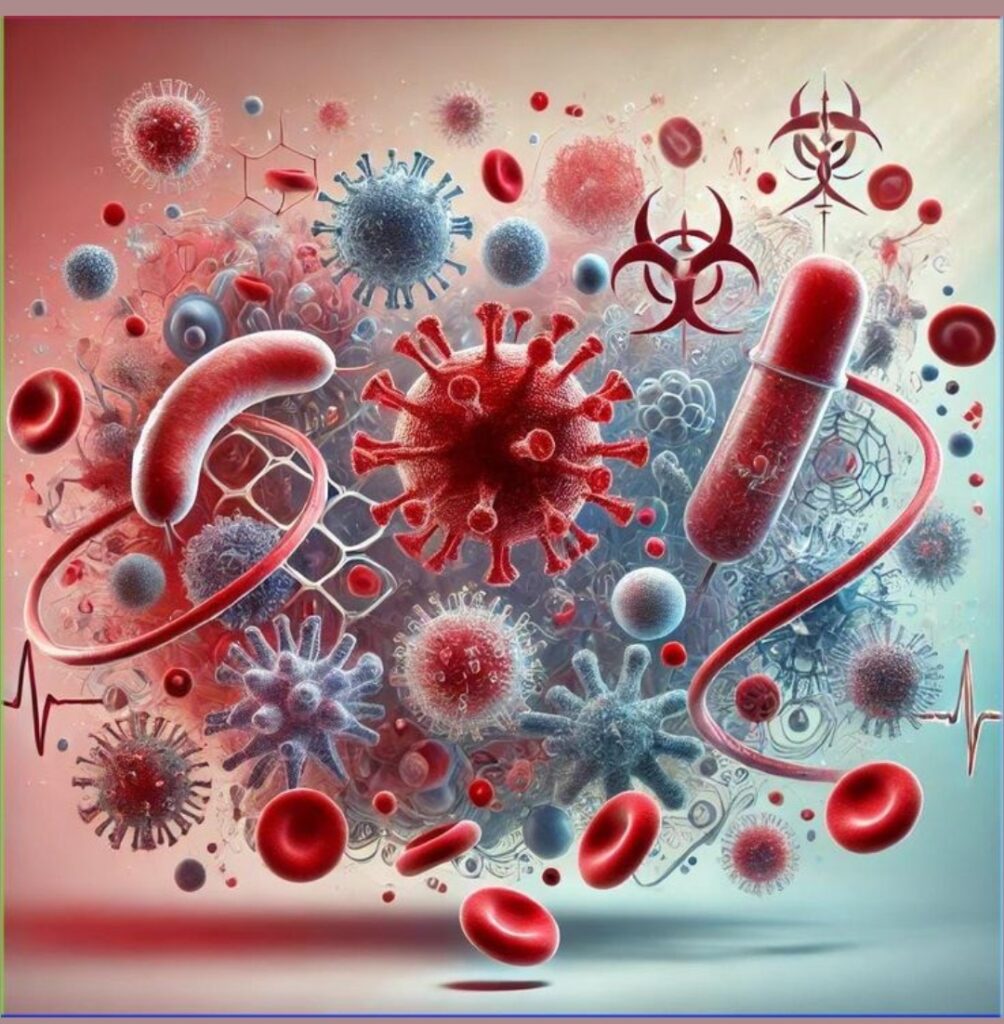
Viruses are among the most important topics in basic microbiology and biology. Questions about viruses commonly appear in competitive examinations because they involve concepts related to structure, genetic material, host cells, replication and disease. Understanding what makes viruses different from cellular organisms is especially important before studying individual viral diseases.
What Is a Virus?
A virus is an infectious biological entity that contains genetic material and can produce new virus particles only by using the machinery of a suitable host cell. Unlike bacteria, fungi and protozoa, viruses do not have a cellular structure. They are therefore described as acellular.
A complete virus particle outside a host cell is called a virion. Viruses contain genetic material, either DNA or RNA, surrounded by protective proteins. Some viruses also possess an outer lipid envelope. The genetic material carries information needed for producing new virus particles, while viral proteins help protect the genome and, in many viruses, assist with attachment to and entry into host cells.
Basic Structure of a Virus
The structure of viruses varies considerably, but three components are particularly important to remember.
First is the viral genome, which may consist of DNA or RNA. A virus does not normally contain both DNA and RNA as its genome.
Second is the capsid, a protein coat that surrounds and protects the viral genetic material.
Third, some viruses have an envelope surrounding the capsid. Viral envelopes are generally derived from host-cell membranes and contain viral proteins or glycoproteins. These surface proteins can help the virus attach to suitable host cells. Not every virus has an envelope, so students should avoid assuming that all viruses have the same structure.
DNA Viruses and RNA Viruses
Viruses can be classified according to the type of nucleic acid in their genome. Some have DNA genomes, while others have RNA genomes.
The genome may also differ in whether it is single-stranded or double-stranded. These differences influence how viral genetic information is copied and expressed inside host cells.
For competitive exams, students should learn common viral examples together with their genome type from the syllabus or standard reference material being followed. Trying to memorise a large number of examples without understanding the basic classification can lead to confusion.
Are Viruses Living?
The question of whether viruses are living or non-living is a classic examination concept.
Viruses possess genetic material and can evolve, but they do not carry out independent cellular metabolism or reproduce independently outside a suitable host cell. For this reason, viruses are often described as non-cellular or acellular infectious entities.
They become biologically active in the context of a host cell, where viral genetic information directs the production of viral components. This dependence on host cells is one of the major differences between viruses and cellular microorganisms such as bacteria.
How Do Viruses Replicate?
Viruses cannot multiply in the same way that cellular organisms reproduce. Instead, they use a host cell to produce new viral components.
A simplified viral replication process can be understood in stages:
1. Attachment: The virus recognises and attaches to suitable receptors on the host cell.
2. Entry: The viral particle or its genetic material enters the host cell through a mechanism appropriate to that virus.
3. Uncoating: In many viruses, the genome is released from its protective structures.
4. Synthesis: The viral genome directs the production of viral nucleic acids and proteins using host-cell resources and, in some cases, virus-encoded enzymes.
5. Assembly: Newly produced viral components are assembled into new virus particles.
6. Release: New virions leave the host cell. Depending on the virus, release may involve cell lysis or budding through a cellular membrane.
The exact replication process differs from one virus to another, so this sequence should be treated as a simplified general model rather than a universal mechanism. Viral replication studies demonstrate how strongly viruses depend on host-cell processes.
Viruses and Host Specificity
Viruses do not infect every cell or organism indiscriminately. Their ability to infect a host depends partly on whether suitable receptors and cellular conditions are available.
This helps explain why different viruses are associated with particular hosts and tissues. Viral surface proteins may play an important role in recognising and attaching to host cells.
Examples of Viral Diseases
Viruses are responsible for many infectious diseases affecting humans, animals and plants. Examples of human viral diseases include influenza, measles, dengue, hepatitis and HIV infection.
Different viruses have different structures, modes of transmission and effects on the body. Students should therefore study individual viral diseases separately after understanding the basic concept of viruses.
It is also important to distinguish viral diseases from bacterial diseases. Antibiotics that target bacterial processes do not generally treat viral infections.
Importance of Viruses
Viruses are not important only because they cause disease. They are also significant in research, molecular biology, biotechnology and medicine. Studying viruses has contributed to our understanding of genetic material, replication, gene expression and interactions between biological systems.
At the same time, viruses can have major effects on populations and ecosystems. Knowledge of viral transmission, replication and control is therefore important in public health as well as biological science.
Virus: Quick Revision
Remember these key points:
- Viruses are acellular infectious entities.
- A complete virus particle is called a virion.
- Viral genomes contain either DNA or RNA.
- The capsid is the protein coat surrounding the viral genome.
- Some viruses possess an additional lipid envelope.
- Viruses depend on host cells for replication.
- Viral replication generally involves attachment, entry, genome release, synthesis, assembly and release.
- Not all viruses have the same structure or replication mechanism.
- Antibiotics are designed to act against bacterial targets and do not generally treat viral infections.
Conclusion
Viruses occupy a unique position in biology because they contain genetic information and can evolve, yet depend on host cells for replication. For competitive-exam preparation, students should first focus on their acellular nature, genetic material, capsid, envelope, host dependence and basic replication cycle.
Once these fundamentals are clear, topics such as viral classification, individual viral diseases and more advanced molecular mechanisms become much easier to understand and revise.
This article provides the foundation for the next level of virus-related topics, including viral diseases, types of viruses and their transmission.