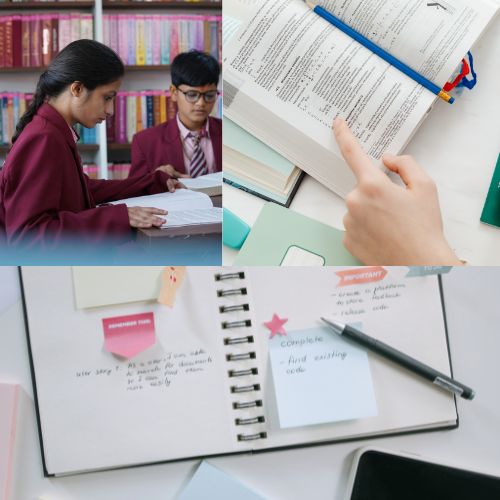
Preparing for a competitive exam is not only about studying concepts and making notes. Regular practice is what turns knowledge into exam-ready skills. Solving questions helps you understand what you know, identify what you have missed, and become more confident with time.
Whether you are just beginning your preparation or have already covered a significant part of the syllabus, effective practice should be an important part of your study routine.
1. Start Practicing After Understanding the Basics
Before jumping into large question sets or mock tests, make sure you understand the basic concepts.
If you have recently started your preparation, first focus on learning the topic properly. Once you have understood it, solve a few questions based on that topic.
This approach helps you move from learning to applying what you have studied.
If you are still at the beginning of your preparation journey, you may first want to understand how to structure your overall preparation. Our guide on [how to start preparing for a competitive exam] can help you build that foundation.
2. Practice Questions Topic by Topic
Instead of randomly solving questions from the entire syllabus, begin with topic-wise practice.
For example, after completing a particular chapter or concept:
- Revise the important points.
- Solve questions related to that topic.
- Check your answers carefully.
- Identify the questions you found difficult.
- Revisit the concept if necessary.
Topic-wise practice makes it easier to identify exactly where you are making mistakes.
As your preparation progresses, you can gradually move towards mixed question sets covering multiple topics.
3. Use Your Study Notes for Practice
Your study notes should not simply be something you read before an examination. They can become an important part of your practice routine.
After studying a topic, use your notes to quickly recall:
- Important facts and concepts
- Formulas and rules
- Definitions
- Key dates or events
- Difficult points
- Common mistakes
Good notes make revision faster and can help you prepare for practice sessions without repeatedly going through an entire textbook.
If you need guidance on creating useful notes, read our article on Study Notes for Competitive Exams.
4. Do Not Avoid Difficult Questions
It is natural to prefer questions that you can answer easily. However, difficult questions often teach you more than the ones you already know.
When you get an answer wrong, don’t simply look at the correct option and move on.
Ask yourself:
Why did I get it wrong?
Was the concept unclear? Did you misunderstand the question? Did you forget a fact? Did you make a calculation error? Or did you run out of time?
Understanding the reason behind a mistake is more valuable than simply knowing the correct answer.
5. Keep a Record of Your Mistakes
One of the most effective practice techniques is maintaining a mistake log.
Whenever you make an important mistake, record:
- The question or topic
- Your incorrect approach
- The correct answer or method
- The reason for your mistake
Review this record regularly.
Over time, you may notice that certain types of mistakes occur repeatedly. Once you identify these patterns, you can specifically work on them instead of spending equal time on everything.
6. Include Timed Practice
Knowing the answer is important, but competitive exams also test how efficiently you can use your time.
Once you become comfortable with topic-wise questions, introduce timed practice.
Set a reasonable time limit and try to complete a group of questions within it. This will gradually improve your:
- Speed
- Accuracy
- Concentration
- Question-selection skills
Do not focus only on speed in the beginning. Accuracy should come first, followed by speed.
7. Gradually Move to Mock Tests
Mock tests are particularly useful once you have covered enough of the syllabus.
Try to recreate actual examination conditions as closely as possible. Sit for the test without unnecessary interruptions and follow the prescribed time limit.
But remember: taking a mock test is only half the work.
The real benefit comes from analysing your performance afterwards.
Check which questions you got wrong, which ones took too much time, and which topics need additional revision.
8. Combine Practice with Regular Revision
Practice and revision should work together. After practising, revise the questions and concepts you found difficult so that your mistakes become learning opportunities.
A simple cycle can be:
Learn → Make Notes → Practice → Analyse Mistakes → Revise → Practice Again
This prevents you from repeatedly studying the same material without knowing whether you can actually apply it.
You can also revisit difficult topics at regular intervals rather than waiting until the examination is near.
9. Study Smart, Not Just More
Effective practice does not mean solving hundreds of questions every day without analysing them.
The quality of your practice matters.
Ten carefully analysed questions can sometimes teach you more than fifty questions that you solve hurriedly and never review.
This is why your overall preparation should focus on smart study rather than simply increasing study hours. If you haven’t already read it, our guide on How to Study Smart, Not Just Hard explains how to make your study time more productive.
10. Build a Consistent Practice Routine
You do not need to wait until you have completed the entire syllabus before you start practicing.
Make practice a regular part of your preparation from the beginning.
A simple routine could include:
Daily: Topic-wise questions and short revision
Weekly: Mixed practice and mistake review
Regularly: Timed tests
After sufficient syllabus coverage: Full-length mock tests
The exact routine can vary depending on your examination, available time, and current level of preparation.
Practice Turns Preparation into Performance
Studying gives you knowledge, but practice teaches you how to use that knowledge under examination conditions.
Don’t be discouraged by wrong answers. Every mistake is an opportunity to discover what needs more attention.
Start with manageable question sets, analyse your mistakes, gradually introduce timed practice, and use mock tests to measure your progress.
The goal is not simply to solve more questions. The goal is to become more accurate, faster, more confident, and better prepared with every practice session.
With a consistent cycle of learning, notes, practice and revision, your preparation can become more structured and effective.